Direct Response Daily ·
Five States Join FTC Hims Lawsuit; Google Widens Ads in AI Mode
Today's brief leads with a widening FTC case over health data sharing, billing and cancellation. It also covers Google's AI Mode ad expansion, OpenAI's new business tools, Meta creative settings and a survey on tracking AI agent leads.
Arizona, Florida, Nebraska, Ohio and Wisconsin join FTC case against Hims and Hers
The FTC filed an amended complaint that adds five states as co-plaintiffs in its lawsuit against telehealth provider Hims and Hers, alongside Utah and California through Los Angeles County Counsel. The agency alleges the company shared consumers' health information with Meta, Snap and other third parties while promising privacy.
The complaint also alleges Hims did not clearly disclose that it bills for prescriptions soon after an intake form is submitted and made subscriptions hard to cancel. Claims cite the FTC Act, ROSCA and state laws. The court will decide the case.
Why it matters
Health and subscription vendors may want to review what ad pixels collect on intake or health pages, how clearly charge timing is disclosed, and how easy cancellation is, as regulators and states appear aligned on these issues.
Source: U.S. Federal Trade Commission: Five States Join FTC Lawsuit Alleging Hims and Hers Engaged in Deceptive and Unlawful Privacy PracticesOfficial · Nov 10, 2026
Google expands AI Mode ads to more English markets and adds follow-up placements in the US
According to Search Engine Journal, Google is bringing ads in AI Mode to more than 10 additional English-language countries, including Australia, Canada, India, Nigeria and Singapore, with Brazil, Mexico and the UK listed as planned for Q4 2026. Pakistan supports text ads only.
Multiturn ads, which can show on follow-up questions in a conversation, are launching in the US. AI Mode results are folded into standard campaign reporting with no separate breakdown, and reported search terms may only approximate what users typed.
Why it matters
Media buyers in these markets should expect AI Mode traffic blended into totals. Watch search terms and lead or sale quality, and avoid assuming any performance shift is caused by AI Mode alone.
Source: Search Engine Journal: Google Expands Ads In AI Mode To 10+ Countries, Adds Multiturn Ads · Nov 10, 2026
OpenAI opens a Business Hub beta with ChatGPT mention and click counts
OpenAI launched Businesses in ChatGPT in beta, letting verified companies claim a profile, correct details, add product feeds and view aggregated counts of mentions and website clicks, PPC Land reports. Eligible US ecommerce and online service businesses can also build Business Agents and sponsor them as a destination for ChatGPT Ads.
OpenAI says it does not share user conversations, and a help note states that clicks do not confirm visits or conversions. Eligibility depends on industry, location and verification checks.
Why it matters
Vendors may want to check how ChatGPT describes their brand and whether their category is eligible. Treat the click counts as directional rather than a substitute for on-site tracking.
Source: PPC Land: Businesses gain ChatGPT click and mention counts in OpenAI's Business Hub · Nov 11, 2026
Google Ads appears to be testing weekly AI insight cards on ad headlines
Some Google Ads accounts show a beta page called Asset activity in the Assets section, according to Search Engine Journal, based on a screenshot shared by practitioner Anthony Higman. Weekly cards suggest headline themes, highlight top headlines by click-through rate and flag industry search trends.
As of November 9, Google had published no help page or announcement about it, and the page warns that its AI output may be inaccurate. Google treats asset-level metrics as directional only.
Why it matters
If the page appears in your account, treat suggestions as test ideas, judge them on conversions at the asset group or campaign level, and review any AI-proposed headline for claims your offer cannot support.
Source: Search Engine Journal: Google Ads Tests A Weekly AI Report Card For Your Ad Creative · Nov 9, 2026
A walkthrough of 47 Meta creative enhancements and which ones one expert disables
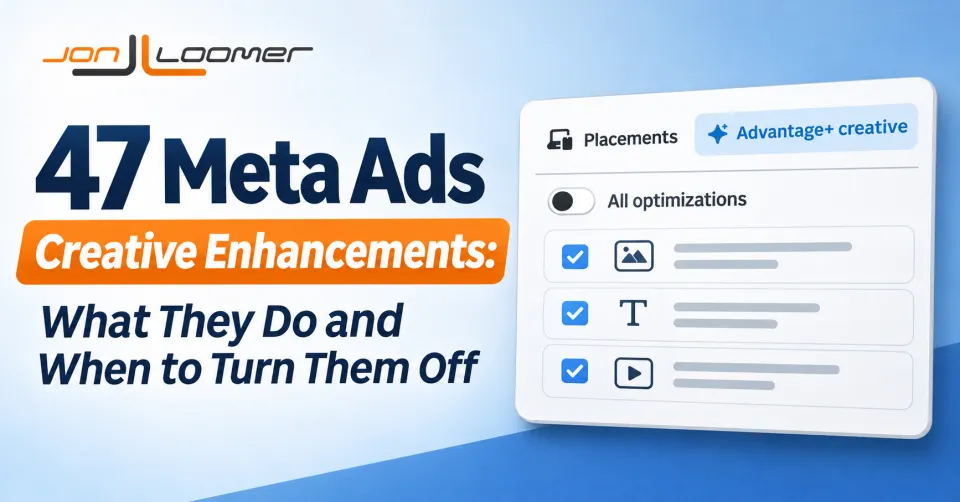
Jon Loomer lists 47 Meta ad enhancements, from AI text, image and video generation and translation to overlays, music and site links, explaining what each does and whether it can be switched off.
He argues many advertisers overreact and leaves several on, but he keeps off settings that can send clicks to a different page, product browsing and in-app browser add-ons such as instant forms, and he rejects AI video showing fake people.
Why it matters
For claims-sensitive copy and VSL funnels, check which enhancements can rewrite text, generate visuals or change the landing page, since unapproved variations may raise compliance and tracking issues.
Source: Jon Loomer Digital: 47 Meta Ads Creative Enhancements: What They Do and When to Turn Them Off · Nov 10, 2026
Invoca survey suggests most brands cannot tie AI agent conversations to sales

Invoca, which sells call tracking and AI agents, released a survey of 451 US consumer-brand marketing leaders. Among the 323 running AI agents, 74% said they cannot fully track an agent-handled lead from click to conversion, and only 19% can reliably send outcomes back to ad platforms, PPC Land reports.
The sample leans toward home services, healthcare and financial services. PPC Land notes the error margin on the subgroup is wider than the stated 4.6 points.
Why it matters
Vendors using chat agents or call centers may want to verify that closed sales from those conversations reach Google, Meta or Microsoft as conversions, since bidding systems learn only from what is reported.
Source: PPC Land: 74% of marketers can't track if AI agent leads become sales, Invoca finds · Nov 11, 2026
How this brief is made: every morning we scan official marketplace and ad platform blogs, regulators and trade press, pick the stories that matter for direct response, and summarize them with AI. Each summary is checked against its source before publishing. Always read the original before acting. Editorial policy.